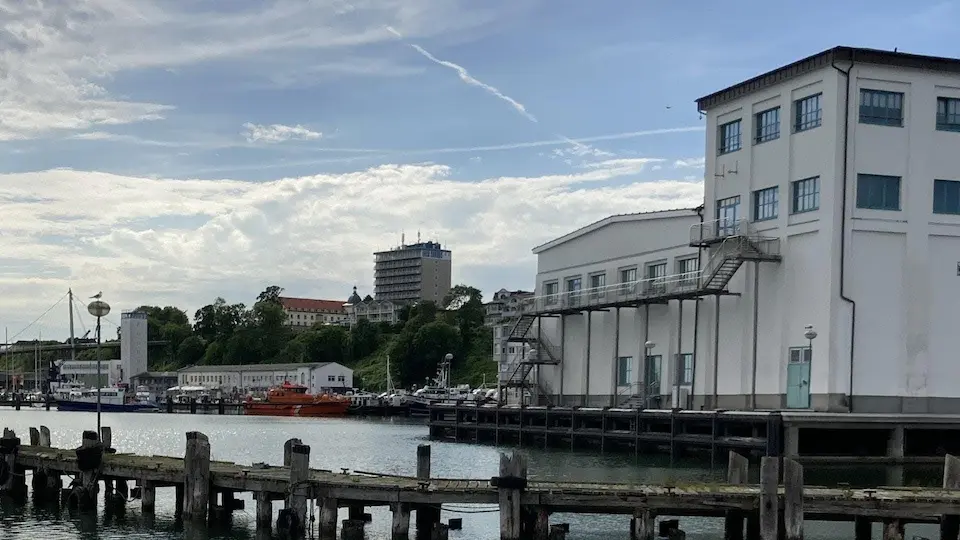
Walking through Sassnitz harbour today, you'll notice traces of the past everywhere:
Some visitors suspect great secrets behind them. In truth, most of these relics tell a different story: that of a harbour that had to get back to work as quickly as possible after the Second World War.
The GDR (the German Democratic Republic – the communist eastern part of Germany that existed from 1949 to 1990) faced severe shortages of materials and money in its early years. At the same time, the harbour was supposed to serve as a fishing port, a ferry terminal, a supply centre, and – because Sassnitz lay near the Baltic Sea border – a secured border zone. What may look improvised today was often simply the most practical solution back then.
New pipelines were laid, quay walls extended, buildings repurposed, and technical facilities erected. Not always beautiful, not always permanent – but functional. This harbour was never about winning architecture awards. It was about getting the job done.
Over the decades, an unusual coexistence emerged. Fishing trawlers lay alongside border patrol boats and other state vessels. Harbour workers, fishermen, sailors, railway men and soldiers crossed paths every day. Sassnitz harbour was never purely military, nor purely civilian – it was both at once.
Many traces of that era are still visible:
If you look closely, you can discover the layers of harbour history in many places.
After 1990, when the GDR was dissolved and Germany was reunified, the picture changed once again. Facilities were abandoned, properties changed hands, railway tracks disappeared, and some structures were demolished or filled in. Much of this happened quickly. Some decisions seem understandable even today, while others are still debated.
That is precisely why a closer look at the old harbour is worthwhile. Because its history is not just about fishing, ferries, or the military. It is above all about the people who worked here – and about a place that has had to reinvent itself time and again.
Anyone seeing the Glass Station for the first time immediately understands why many Sassnitz locals still associate it with Sweden.
The distinctive blue and yellow colours are no coincidence – they echo the national colours of the neighbouring country. For nearly nine decades, the famous ferry route to Trelleborg – the so-called "King's Line" – departed from here. For countless travellers, this was the first or last piece of Germany on their journey across the Baltic Sea.
The current Glass Station was built in 1959 as a modern terminal for international ferry traffic. In the GDR (the communist East Germany of the time), the project was a prestige endeavour – a chance to present the country as modern and open to the world. While the massive cold storage building, the ice tower, and the long fish-processing halls had been erected just a few years earlier, the new station set a different accent: lightness and transparency.
Here, too, architecture followed its purpose strictly. But instead of storing cold or processing fish, this building was designed to receive, guide, and accommodate people. That is why it received its striking glass facades.
The light-flooded hall offered travellers an unobstructed view of the Baltic Sea, the arriving ferries, and the busy harbour activity. Slender structural supports, large window surfaces, and open spaces gave the building a lightness that was considered remarkably modern at the time.
Architecturally, the Glass Station marks the transition from the early, rather massive post-war buildings to the sober East German Modernism of the late 1950s – a style emphasising clean lines and functionality. Yet to this day, it harmonises surprisingly well with the neighbouring cold storage building, the ice tower, and the production halls.
The reason lies in a shared idea: all these buildings were designed as pure functional structures. Their form derives directly from their purpose. No ornamentation, no facades for their own sake – but architecture that explains what happens inside. Thus, the cold storage building forms the heavy end of fish processing, the ice tower stands as the technical hub, and the Glass Station serves as the transparent gateway to the world.
Together, they tell of a time when the Sassnitz harbour was conceived as a single, large machine – for fishing, rail, and shipping all at once.
Today, no trains roll onto the ferries from here. But the Glass Station remains – a monument to an era when Sassnitz was not just the end of a railway line, but one of the most important links between Germany and Scandinavia.
Walking along Sassnitz's town harbour today, it is easy to overlook that one of the last intact industrial ensembles from the early 1950s has been preserved here. While other harbour cities often demolished their old industrial sites completely after the Wende (the peaceful revolution and German reunification in 1990), this contiguous strip along the quay wall has been preserved as a coherent monument.
Where the upper town's bourgeois seaside resort architecture shines with playful wooden details, this complex forms the historical, robust counterweight. It shows that Sassnitz was not merely a picturesque spa town, but the industrial heart of the island of Rügen. A closer look at the building fabric reveals how masterfully the architects of the time balanced brutal functionalism with genuine urban aesthetics.
This area was not created piecemeal by chance; it was designed as a "great socialist construction project" on the drawing board. With the founding of the VEB Fischkombinat Sassnitz (a state-owned enterprise of the GDR) in 1949, the government had a clear goal: Sassnitz was to become the most modern deep-sea fishing centre in the country. Since the harbour facilities had been severely damaged in the Second World War, the planners seized the opportunity for a radical redesign.
The real masterstroke was geographical: they used the topographical narrowness – the steep chalk cliff at the back and the quay edge at the front – as a perfect design corset. The result was a highly efficient, west-to-east production line, perfectly coordinated in every step.
The architectural style: The buildings reflect the exciting early phase of GDR architecture. It is a purist, monumental industrial style that consciously distances itself from the ornamental villas of the holidaymakers. Here, so-called Socialist Classicism (a blend of traditional monumentality and clear, functional forms) meets uncompromising functionalism: no frills, no stucco – form follows function absolutely. Despite their massive scale, the buildings nestle harmoniously against the steep hillside of Sassnitz's upper town, thanks to their elongated form.
Anyone looking up from the harbour to the high shore today sees one of the town's most distinctive buildings. When the Rügen Hotel opened in 1969, however, it was much more than just a hotel.
It was one of the GDR's showcases to the West.
The reason lay directly below the building. In the town harbour, the ferries of the King's Line to Sweden docked – and Sweden was an important, non-communist neighbour for the GDR. Sassnitz was therefore one of the few places in East Germany where international travellers arrived and departed daily. For many visitors from Scandinavia, the Rügen Hotel was their first impression of the "East".
Expectations were accordingly high: the hotel was meant to demonstrate that the GDR was modern, open-minded, and capable – despite the political division of Germany and the Cold War.
With the support of the Swedish construction company SIAB, a modern building with 120 rooms, restaurants, a dance bar, swimming pool, sauna, and an Intershop (a special shop where only Western currency could be spent) was built above the harbour. For the GDR, the hotel was both a prestige project and an important source of foreign currency.
Guests came mainly from abroad. Swedish tour groups regularly stayed here, as did officials, artists, and other privileged visitors. For many locals, the hotel initially remained a world they only knew from passing by – it was originally conceived as a transit hotel for international travellers, not as a holiday hotel for everyone.
This is precisely why the Rügen Hotel holds a special place in the town's history. While the fishing combine was responsible for the catch and the Glass Station handled the travellers, the hotel represented the international side of the harbour. Here, the GDR wanted to show that it was modern, cosmopolitan, and efficient – an important aspect in the East-West system competition.
Architecturally, this ambition is still reflected today. The large structure towers over the harbour and is visible from afar. Unlike the playful villas of the old town, the hotel adopts a clear, modern formal language of the late 1960s – functional, sober, but still representative. It was meant to stand out – and it still does.
After Germany's reunification in 1990, a new chapter began. Since 1995, the house has been run by a family-owned company. With a comprehensive renovation since 2023, they are striving to give the historic building back the significance it once had for Sassnitz.
Because even though times have changed, the Rügen Hotel remains what it always was: a widely visible landmark above the harbour – and a piece of German-Scandinavian history.
Anyone strolling through Sassnitz's old town for the first time quickly notices that something is different here compared to many other Baltic seaside resorts:
Instead, narrow alleys climb the slope, staircases disappear between houses, and behind almost every corner a new view opens up over the Baltic Sea or the rooftops of the town.
The reason lies in the landscape. When Sassnitz grew from a small fishing village into a popular bathing resort in the 19th century, the town had to expand in a confined space. The steep slopes of the Jasmund peninsula did not allow for generous urban plans. So the old town developed wherever there was room – between hills, chalk cliffs, and ancient paths. Thus, a winding network of lanes, steps, and small squares evolved, which has been preserved to this day.
Between the narrow streets stand the typical white villas of seaside resort architecture – a style that became popular along the Baltic coast around 1900. Many feature:
Unlike in some other Baltic resorts, the architecture here often feels more personal and less representative. Particularly charming is the contrast between the grand summer residences of wealthy holidaymakers and the much smaller former fishermen's houses that still stand between them in many places. Both belong to Sassnitz – the fishing village as much as the seaside resort.
Around the Old Market, the heart of the old town still beats today. Here, many of the small paths through the quarter begin. Cafés, restaurants, studios, and galleries have found their place in the historic buildings, giving the old town centre a relaxed, almost village-like atmosphere.
If you walk attentively through the lanes, you will also repeatedly come across the so-called "Bloompötte" – rounded flint stones from the Baltic Sea, lovingly used by residents as flower pots. A small but typical detail that shows how deeply the people here are connected to the coast.
Perhaps it is precisely this mixture that gives the Sassnitz old town its special character: It does not feel like a planned seaside resort, but like a place that has grown over generations – with all its nooks, crannies, and surprises.
Visitors to Sassnitz town harbour usually first set their eyes on the white silhouette of the chalk cliffs. The most impressive perspective on the UNESCO World Heritage site of Jasmund National Park, however, is not from land, but from the water. Regular excursion boats depart directly from the berths in the town harbour – heading for the heart of the coast.
Route and onboard experience
The classic round trips last about 1.5 hours. First, you travel about 40 minutes along the coastline, past the ancient beech forests of the UNESCO World Heritage site. Through loudspeakers, guests learn about geology, ecology, and historical coastal collapses – for example, those of the famous Wissower Klinken. The highlight of the tour is the turning point at the Königsstuhl: in front of the 118-metre-high, floating rock formation, the ship slows down to give you time for exclusive photos from the water perspective. The return journey (another 40 minutes) takes you relaxed back to the harbour. All ships have outdoor and indoor decks as well as onboard catering with coffee, drinks, and snacks.
Practical information
Regular scheduled services run from April to October with several departures daily. In winter, only limited or special dates are available. Tickets can be purchased at the kiosks on the harbour promenade or online from the shipping companies – please arrive 15 to 20 minutes before departure. Schedules are wind- and weather-dependent; in rough seas, there may be short-notice changes or cancellations. A note for romantics: on some of the traditional, smaller vessels, only cash is accepted on board.
Experience the rugged beauty of Rügen from the seafarers' perspective – the captains and crews at Sassnitz town harbour look forward to welcoming you on board.
For over 100 years, guests have travelled from here to the chalk coast – a tradition that has lost none of its fascination to this day.
Even in the Roman Empire, the combination of bread and fish (Latin: panis cum pisce) was considered the perfect on-the-go meal. Back then, however, it was dry and bland.
If you prefer it freshly caught, crunchy, and varied, head straight to the food trawlers in the old harbour. The best antidote to ancient paperwork.
Tip: Seagull lovers order their fish roll directly 'auf die Hand' – to eat on the go.
What once sustained fishermen at sea is now the epitome of harbour culture. It doesn't get any fresher than this.
Directly in the Molenfuß building at the entrance to the pier and the old harbour lies the official Tourist Service of Sassnitz. Werner Wiedorn and Mareike Dorn and their team welcome guests here – not an anonymous service centre, but a personal point of contact with years of local knowledge. In addition to accommodation booking, the staff are happy to help with excursion planning, sell ferry tickets as well as admission tickets for boat trips along the chalk coast and regional events. If you prefer to explore on your own, you can get free city maps and hiking maps for the Jasmund National Park here. The small shop also sells souvenirs and magazines – a pleasant addition for anyone wanting to take a little something home or pick up some reading material for the journey. Open 365 days a year, including weekends and public holidays. Not a big tourist melting pot, but a personal contact on site – with insider tips and an open ear for guests and hosts alike.
The "Sassnitzer Hausgeister" – a cleverly designed network of six themed routes – invite you to explore the multi-layered history of this harbour town at your own pace. One route takes you along the magnificent seaside architecture of Alt Sassnitz, another into the rugged world of the fishermen in Alt Crampas. The town harbour tells of seafaring and trade, while the area around Dwasieden Castle touches on military and aristocratic history. Those seeking the modern era can follow the traces of town development during the GDR era – or those of chalk mining, which once shaped the region's prosperity. Flexible, knowledgeable, and refreshingly free of overbearing guidance. A self-determined stroll through seven epochs – history can be this entertaining.